
The Circuit of Power: How Portable Jump Starters Really Work
Turning the key to start your car instantly places a huge demand on the battery – typically 200-800 amps, depending on engine size and temperature. But what if the battery is dead? The demand still exists, but there is no supply to meet it. Portable jump starters represent a way to deliver on the massive energy demand to get a dead car running again.
What you might not know is this: portable jump starters need a virtually resistance-free pathway from their own internal batteries straight to the target vehicle’s starter motor. Any amount of resistance limits a jump starter’s effectiveness. Moreover, jump starter quality matters as well. A good unit can overcome resistance, while a lower-quality unit will fizzle and fail.
The Path of Power
Electricity is a curious beast. Raw, untamed power packs quite a punch. But it doesn’t take much resistance to stop it in its path. So when it comes to jumping a car with a dead battery, you are looking at a high-amp race against time.
The power from your jump starter follows a very precise sequential path:
-
Chemical Discharge – Power originating from the jump starter’s battery cells is produced by an internal chemical reaction that liberates electrons and sends them from the negative to the positive side. The unit outputs this energy as electricity.
-
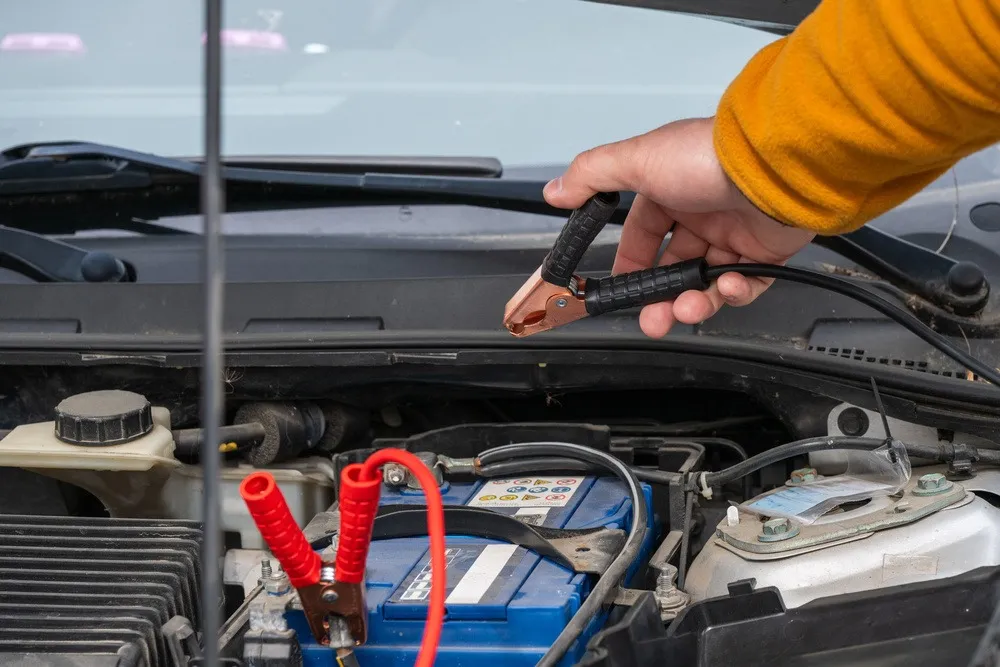
Cable Transmission – The electricity travels as current through external booster cables composed of heavy-duty internal wiring. The cables are connected at the other end with metal clamps.
-
Terminal Junction – The jump starter’s clamps are connected at two points: the battery (positive) and chassis or engine block (negative). A small amount of electricity is diverted to the dead battery, but the majority of it is fed directly to the car’s starter circuit.
-
Starter Engagement – Current running through the starter circuit and down to the starter motor ultimately engages that motor. Engagement happens through an electromagnetic process that creates the torque necessary to turn the flywheel.
Without a portable jump starter in play, a fully charged battery sends current down that same starter circuit. Jumping is the exact same process – except for the fact that the jump starter provides the power rather than the dead battery.
Resistance: The Enemy of Performance
In a perfect world, nothing stands in the way of electricity running directly from a portable jump starter to the car’s starter motor. But things are rarely perfect. According to Clore Automotive, makers of the industry-leading Jump-N-Carry brand, multiple things can cause significant resistance. Unfortunately, resistance is the primary enemy of jump-starter performance.
Resistance is like a bottleneck in circuit. Whenever current encounters resistance, voltage drops commensurately. The result is usable electrical energy being converted to heat rather than actually engaging with the starter motor. Clore Automotive says there are three primary factors that contribute to performance-inhibiting resistance:
-
Internal Battery Resistance – All automotive batteries are subject to internal resistance. Inferior cell chemistry and age can both restrict electron movement within a jump starter’s internal battery.
-
Cable Impedance – Current can be impeded by low-quality or thin-gauge wiring that chokes electrical flow in much the same way a kinked hose prevents water flow.
-
Contact Resistance – Oxidation, dirt, and grease inhibit performance by creating resistance at terminal connections. Likewise, poor clamp spring tension leaves gaps between clamps and terminals, creating even more resistance.
For a portable jump starter to work as expected, it needs a clear path through which to deliver power. If there is any resistance in that path, performance will degrade. Is it any wonder professionals do not rely on consumer-grade booster packs, opting for commercial-grade jump starters instead?
