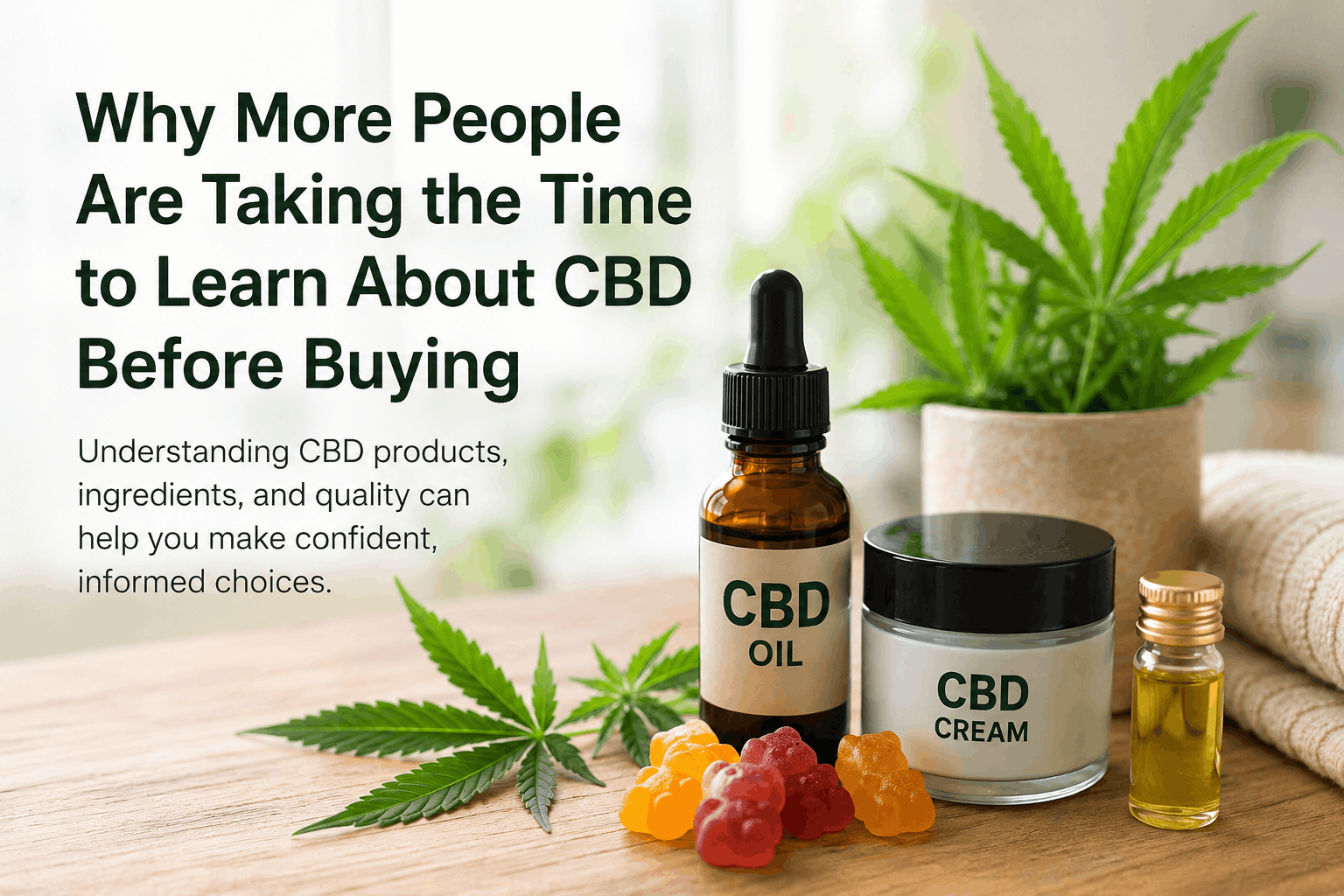

CBD has gone from being a relatively unfamiliar wellness ingredient to something found in creams, oils, gummies, balms, and a growing range of everyday products.
But greater availability has also created a new challenge for consumers: figuring out what all of these products actually mean.
Terms such as broad spectrum, full spectrum, CBD isolate, milligrams, topical CBD, and third-party testing can make shopping confusing, particularly for someone trying CBD for the first time.
That is why education has become an increasingly important part of the CBD buying process.
CBD Products Aren’t All the Same
One of the biggest misconceptions surrounding CBD is that two products labeled “CBD” are essentially interchangeable.
In reality, formulations can differ considerably.
Products may contain CBD isolate or a broader range of hemp-derived compounds. Some are designed to be swallowed, while others are formulated specifically for topical application.
Concentration can also vary dramatically.
A consumer might encounter a relatively low-potency topical alongside another product containing thousands of milligrams of CBD. Comparing those products based solely on price doesn’t provide the full picture.
Understanding the concentration, serving size, ingredients, intended use, and type of hemp extract gives consumers much more useful information.
Understanding the Different Types of CBD Products
CBD is now available in several forms, and each has characteristics worth understanding before purchasing.
CBD oils are typically taken orally and allow consumers to adjust the amount they use relatively easily.
CBD gummies provide CBD in a premeasured edible format and have become popular because of their convenience.
CBD creams, salves and balms are applied directly to the skin. These products may also contain ingredients such as menthol, botanical extracts or moisturizing ingredients.
Consumers interested in exploring these differences can learn more about CBD through educational resources covering CBD basics, topical products, common questions, research, regulations and other frequently discussed CBD topics.
Having access to this information can make comparing products considerably easier.
Why CBD Strength Deserves Attention
Another area that frequently causes confusion is CBD potency.
A large number printed on the front of a package may look impressive, but consumers need to understand what that number represents.
For example, the total amount of CBD in an entire container isn’t necessarily the same as the amount used in a single serving or application.
Container size matters as well.
Comparing a small container containing a particular amount of CBD with a much larger container containing the same amount doesn’t necessarily provide an apples-to-apples comparison.
Looking at both CBD concentration and product size provides better context.
This becomes particularly important with topical products because concentrations can vary substantially between brands and formulations.
Look Beyond the Front Label
Good shopping habits also involve turning the package around and examining what’s actually in the product.
Consumers may want to consider:
- The complete ingredient list
- Total CBD content
- Container or serving size
- Type of hemp extract
- Whether THC is present
- Additional active or botanical ingredients
- Usage instructions
- Available laboratory testing
For topical products, additional ingredients can have a noticeable effect on the experience.
A cooling cream containing menthol, for instance, will feel very different from an unscented moisturizing CBD cream even when both contain similar amounts of CBD.
Neither formulation is automatically better. They are simply designed differently.
Third-Party Testing Matters
Independent laboratory testing has become another important consideration when evaluating hemp-derived products.
A certificate of analysis, commonly called a COA, can provide information about cannabinoid content and help consumers determine whether the product matches what is represented on the label.
Depending on the testing performed, laboratory reports may also provide screening information for contaminants.
Consumers shouldn’t have to rely exclusively on marketing language when evaluating a CBD product.
Transparency provides another layer of information they can use when deciding what they are comfortable purchasing.
Be Careful With Big Health Claims
CBD marketing can sometimes get ahead of CBD research.
Although researchers continue studying cannabidiol and the endocannabinoid system, CBD should not be viewed as a cure-all.
Consumers should be particularly cautious when encountering products that promise to diagnose, treat, cure or prevent serious diseases.
Educational information should help people understand what CBD is, what research has examined and where uncertainty remains rather than promising guaranteed outcomes.
Anyone considering CBD for a medical condition or taking medications should discuss it with an appropriate healthcare professional.
Education Creates Better Consumers
The CBD market has matured considerably, and consumers are becoming more sophisticated along with it.
People increasingly want to know where products come from, what’s inside them, how much CBD they’re actually getting and whether laboratory testing is available.
That’s a positive development for the industry.
Instead of choosing a product because it has the biggest number on the label or the boldest advertising claims, informed consumers can compare products based on factors that actually matter to them.
CBD doesn’t need to be complicated.
Learning a few fundamentals about cannabinoids, formulations, potency, ingredients and testing can make navigating the market much easier—and help consumers make purchasing decisions with greater confidence.
